
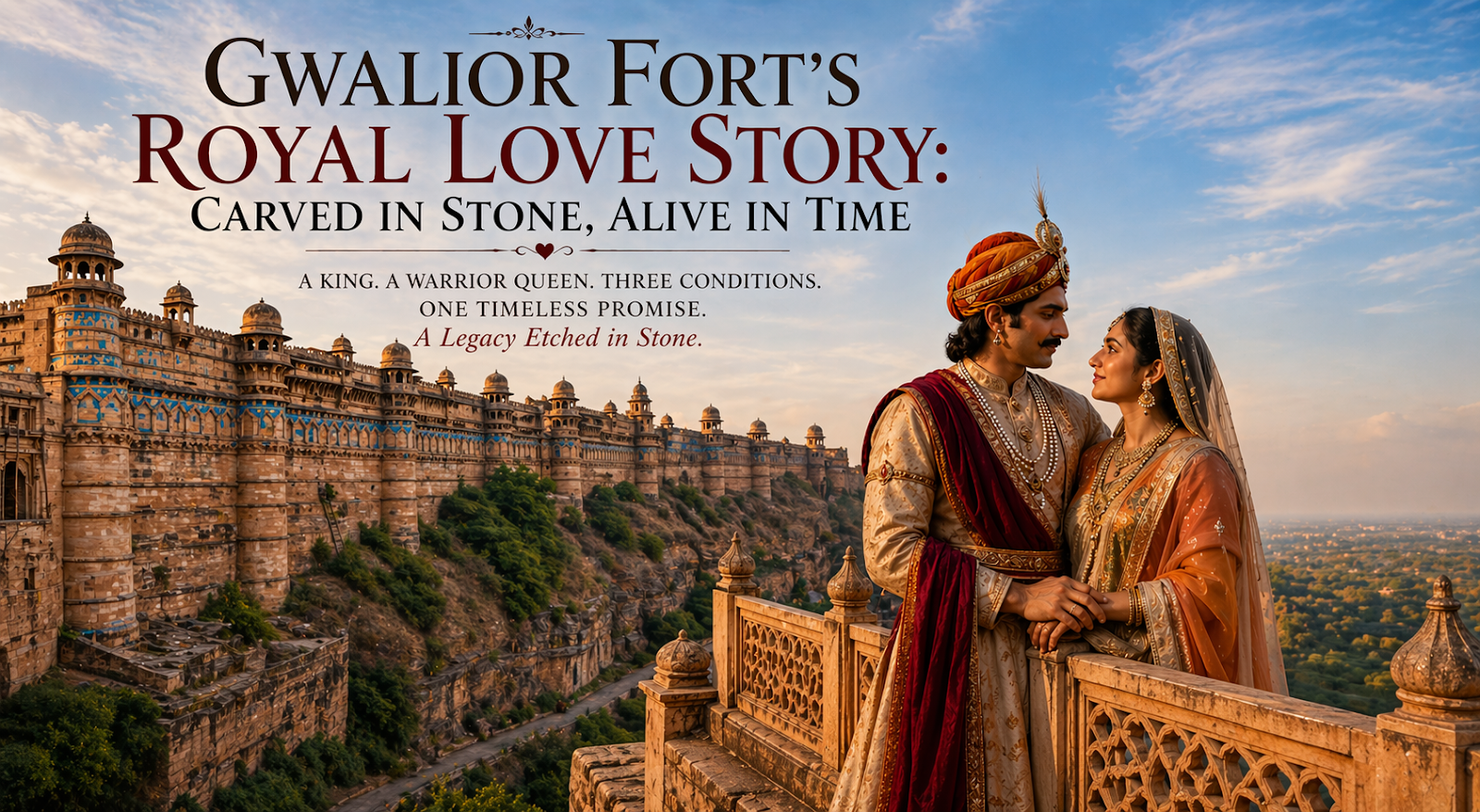
Source: ChatGPT
On a sandstone plateau rising above the plains of central India stands Gwalior Fort, not merely as a fortress but as a silent witness to the passage of time. Its inviolable walls have seen empires ascend and crumble, battles rage and fade, and the graceful bloom of music, art, and devotion. Yet within its vast expanse lies a quieter legacy: a story of love.
Even today, the winds that drift across the fort do not sing of valour alone; they also echo an eternal love, softened by the years but never erased. It is a love story that, in its own way, reshaped the destiny of the fort itself.
This is the story of Maharaja Man Singh Tomar and Rani Mrignayani, a romance that challenged hierarchies, transcended social boundaries, and found its most enduring expression in stone: the elegant Gujari Mahal.
The tale unfolds in the late 15th century, during the reign of Raja Man Singh Tomar (1486–1516), a ruler of the Tomar dynasty and among the most culturally dynamic kings of Gwalior. Under his guidance, Gwalior Fort transformed from a mere military bastion into a thriving centre of music, architecture, and artistic excellence.
Like many legends, this love story begins far from the formalities of the royal court, in the wilderness. As oral traditions recount, during a hunting expedition, the king came across a young woman of the Gurjar community named Ninni. She was not dressed in royal finery; instead, she radiated a striking presence marked by courage and an untamed sense of individuality.
In a moment that challenged the rigid norms of a feudal society, the king witnessed her confronting a wild buffalo. The encounter was intense, yet the young woman stood unwavering, unveiled, and fearless. Ultimately, it was the animal that retreated, and her courage that triumphed. Such a sight was extraordinary: a woman defying societal expectations, displaying strength and skill with poised confidence.

Source: Google Gemini
Deeply captivated, the king is said to have been struck by her expressive, doe-like eyes, giving her the name “Mrignayani: the one with eyes like a deer.” Perhaps even he did not realise when his heart, like a lotus drawn to still waters, quietly surrendered to the depth of her gaze.
Mrignayani wore no royal ornaments, yet she was adorned with qualities far more compelling: her bravery, her independence, her refusal to conform, and her combat prowess. It was not simply her beauty that enchanted Raja Man Singh, but the strength of her character. In her, he discovered not only grace, but spirit, and it was this rare union that bound him in a silent, inescapable embrace of love.
When Raja Man Singh placed his heart before Mrignayani, it was not met with quiet acceptance, but with remarkable resolve. Standing with elegance and quiet authority, she placed three conditions before the Maharaja, conditions that reflected not defiance, but dignity. She desired a residence of her own, separate from the confines of the royal palace. She insisted on a dedicated supply of pure water from the nearby Rai River, along whose banks her native village was nestled. And most striking of all, she declared that in times of war, she would not remain behind in comfort, but would stand beside the king, sharing both his dangers and his destiny.
It was a bold negotiation, rare for its time; her fearless spirit is remembered with deep respect in Gwalior.
Moved by her grace and strength, the Maharaja accepted all three conditions without hesitation. From this sacred bond of love and respect arose the magnificent Gujari Mahal, a palace created not by royal command but by a promise honoured.
An ingenious water system was engineered to channel fresh water from the Rai River, fulfilling her wish and preserving her connection to her roots. The structure itself reflects a seamless blend of functionality and elegance, where architectural beauty meets emotional depth.
Gujari Mahal is more than a monument of love. It is a living testament to Mrignayani’s individuality and dignity, and to Raja Man Singh’s rare courage to honour love above tradition, even as a king.
Centuries have passed, empires have risen and fallen, yet the story of Mrignayani and Maharaja Man Singh continues to resonate. Gujari Mahal does not speak only of beauty or grace; it redefines love itself. Here, love is not delicate; it is resolute. It is courage that dares, dignity that stands firm, respect that listens, and devotion that endures beyond time.
Unlike many tragic love stories marked by separation or sacrifice, this tale is one of fulfilment, a rare narrative where love leads to creation, not destruction.
Even today, Gujari Mahal rises with quiet pride against the sky, firm, unbending, self-assured, much like the conditions once set by Rani Mrignayani. In its presence, one can sense a subtle defiance that redefined conventions, standing as a crown jewel of Gwalior’s heritage.
Visitors walking through the corridors of Gujari Mahal today do not merely witness history; they encounter a story in which architecture becomes poetry and stone becomes memory.
Beneath the timeless shadow of Gwalior Fort, the story of Maharaja Man Singh Tomar and Rani Mrignayani lingers not as a distant legend, but as a living echo, a reminder that the most powerful legacies are not built in battle or conquest, but in love that dares to stand its ground.
Here, love rises above time, untouched and eternal.
Archival Records
1. Jadon, Siddharth S., and Anjali S. Patil.“Digital Reconstruction of Mansingh Palace Using Historical Descriptions and Site Analysis.” Digital Applications in Archaeology and Cultural Heritage, Vol 38, June 2025. e00439.https://doi.org/10.1016/j.daach.2025.e00439.
2. Solanki, Anjali. “The Gujari Mahal: A Timeless Tribute to Love and Courage.” EBNW Story. June 2025. https://ebnw.net/travel-tourism/the-gujari-mahal-a-timeless-tribute-to-love-and-courage/.
3.“The Gujari Mahal: A Testament of Love at Gwalior Fort, Madhya Pradesh.”
Culture and Heritage. January 2024. https://cultureandheritage.org/2024/01/the-gujari-mahal-a-testament-of-love-at-gwalior-fort-madhya-pradesh.html.


No comments:
Post a Comment