
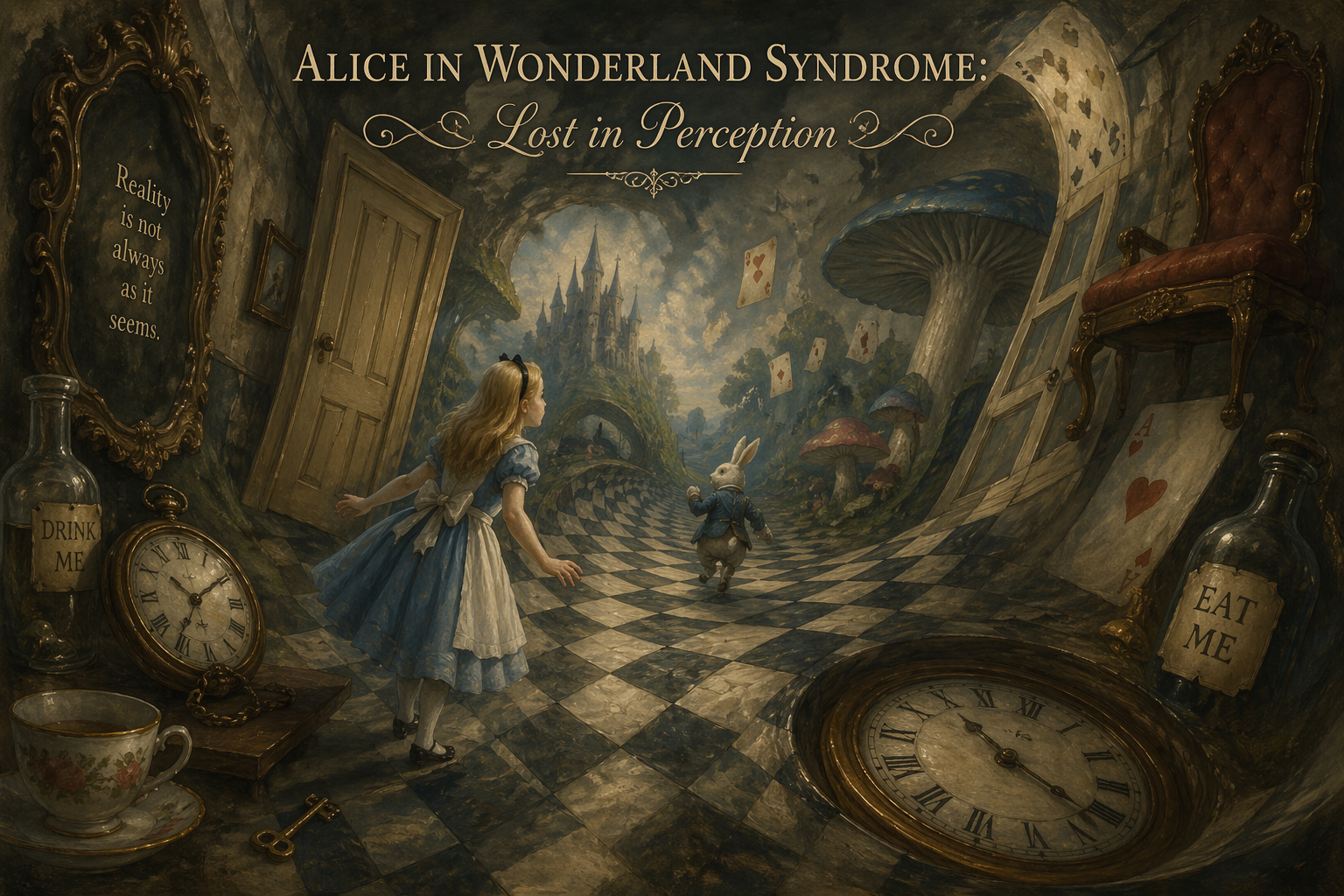
Source: ChatGPT
On an evening, a girl sits quietly, her attention fixed on a simple cup placed on the table. Suddenly, something unusual occurs: the cup seems to swell until it appears as large as a bucket. At the same time, her hand feels unusually small, almost distant, as if it does not truly belong to her body.
This strange and unsettling shift in perception is characteristic of a rare neurological condition known as Alice in Wonderland Syndrome (AIWS).
Alice in Wonderland Syndrome, also called Todd’s syndrome or dysmetropsia, is a condition in which the brain’s interpretation of size, shape, and spatial distance becomes distorted. As a result, objects may appear abnormally large, unusually small, displaced in distance, or strangely reshaped. In some cases, this altered processing also affects body awareness, making individuals feel as if parts of their body are either enlarged, reduced, or unfamiliar.
The condition was first formally described in 1955 by British psychiatrist Dr John Todd, who noticed a pattern among patients experiencing these unusual perceptual changes, often alongside migraine headaches. He proposed a possible neurological link between the syndrome and migraine-related brain activity.
Interestingly, Dr Todd also drew a literary connection to Lewis Carroll’s famous novel Alice’s Adventures in Wonderland. Lewis Carroll, the author of the book, is believed, based on later neurological interpretations, to have experienced migraine episodes with sensory disturbances, which may have influenced the surreal distortions of size and space described in his writing.
Because of this association between the symptoms and Carroll’s literary world, the condition was eventually named after the novel itself.
Signs and Symptoms
AIWS presents a complex spectrum of more than 60 reported symptoms, broadly divided into self-perception and visual-perception disturbances. Notably, only about 9% of patients experience alterations in body awareness, where their form may feel unusually small (microsomatognosia) or excessively large (macrosomatognosia).
In contrast, nearly 75% report visual perception changes involving external surroundings. Objects may appear stretched, shrunken, or distorted in size, and distances may seem misleading, making things feel closer or farther than they truly are. These unusual perceptual shifts highlight how AIWS temporarily alters the brain’s interpretation of both the body and the surrounding world.
Causes
While the exact cause of Alice in Wonderland Syndrome remains unclear, it is associated with several underlying conditions. These include neurological disorders such as migraine, epileptic seizures, brain tumours, and degenerative diseases like Creutzfeldt-Jakob disease, as well as psychiatric conditions such as schizophrenia and depressive disorders.
In children, the syndrome is frequently associated with infections from pathogens such as Epstein–Barr virus, Varicella-Zoster virus, Influenza, Lyme disease, and Scarlet fever. In some cases, prolonged use of certain medications, including montelukast, dextromethorphan, and topiramate, as well as exposure to hallucinogens like lysergic acid diethylamide, has also been reported to trigger similar symptoms.
Affected Population
AIWS is considered rare, partly due to limited research and underreporting of cases. It is most commonly observed in children, with some studies suggesting that nearly two-thirds of diagnosed cases occur in individuals under 18 years of age. Research also indicates that around 30% of teenagers may experience brief, transient episodes of AIWS-like symptoms at some point. Despite these observations, clinically significant cases remain uncommon; between 1956 and 2016, fewer than 200 cases were documented as severe enough to require medical attention.
Diagnosis
The electroencephalogram (EEG) is one of the key diagnostic tools used in evaluating brain-related conditions associated with AIWS. It records the brain’s electrical activity and helps identify abnormalities such as epilepsy, brain tumours, and other neurological disturbances that may contribute to the syndrome.
In addition, imaging techniques are used to detect structural changes in the brain that may be responsible for AIWS symptoms. The visual evoked potential (VEP) test assesses the functioning of the visual pathway, including how the eyes and neural networks transmit signals to the brain.
A spinal tap (lumbar puncture) may also be performed to check for infections in the cerebrospinal fluid (CSF), which can sometimes trigger AIWS.
Treatment
Unfortunately, there is currently no specific or definitive treatment for Alice in Wonderland Syndrome. Management primarily focuses on identifying and addressing the underlying cause of the condition, as therapy depends on the individual’s specific medical situation and associated symptoms. In many cases, treating the root disorder, such as migraine, infection, or seizure activity, can significantly reduce or resolve the perceptual disturbances.
Alice in Wonderland Syndrome is a brain condition that affects how a person sees and understands the world. It involves changes in perception and brain function. Although it is not often diagnosed, studies suggest it may happen more often for a short time, especially in children and people with migraines. New brain research is helping scientists better understand how the brain creates our sense of reality.
Despite its striking symptoms, AIWS is typically benign and reversible. However, further large-scale studies are required to fully understand its mechanisms, improve diagnostic accuracy, and develop targeted therapies.
The Source Trail
-
Alice in Wonderland Syndrome. Cleveland Clinic. 2025. Available from: https://my.clevelandclinic.org/health/diseases/24491-alice-in-wonderland-syndrome-aiws
-
Blom JD. Alice in Wonderland syndrome: A systematic review. Neurology Clinical Practice. 2016;6(3):259-270. Available from: https://pmc.ncbi.nlm.nih.gov/articles/PMC4909520/
Recommended Reading
- https://www.hktechnical.com/2026/04/butterflies-in-stomach-metaphor-or.html
- https://www.hktechnical.com/2026/04/3d-printed-medicines-new-era-for-indian.html
Disclaimer
The girl described in the introductory passage is a fictional character created solely for illustrative purposes. She does not represent any real individual, and the scenario is intended only to help explain the perceptual experiences associated with Alice in Wonderland Syndrome (AIWS).


No comments:
Post a Comment