
You have just come out of surgery and the first advice you hear is:
"You need to start exercising."
Exercise did not help
Let me give you some personal anecdotes:
In the 1990s my grandmother, who was in her 80s, developed a frozen shoulder. She was otherwise physically fit and mentally sharp for her age.
However, the physiotherapist on the very first day, had her do the entire set of shoulder exercises at full range. She came home exhausted. She couldn't even go back for the next session. She had to wait for almost 2 weeks before she could start again. So I just led her through the exercises slowly and gently. Gradually, her confidence returned. Then her movement improved. That experience has stayed with me.
Recently, history repeated itself.
My mother had a pacemaker implanted. Before she had even recovered from the shock of surgery, everyone around her had the same advice.
"Start walking. Walking is good for you. Get up and walk."
Again, I had to step in.
A person who has just had surgery is not only weak physically, but they are mentally exhausted. They are trying to reconcile with what they have just been through.
Exercising will not tackle this problem.
The same thing happens every day in clinics.
Someone is diagnosed with diabetes or high blood pressure. They're told:
- Eat healthy.
- Exercise.
- Lose weight.
Sounds simple.
But inside, that person is already in a turmoil. They're overwhelmed, frightened, and have no idea where to begin.
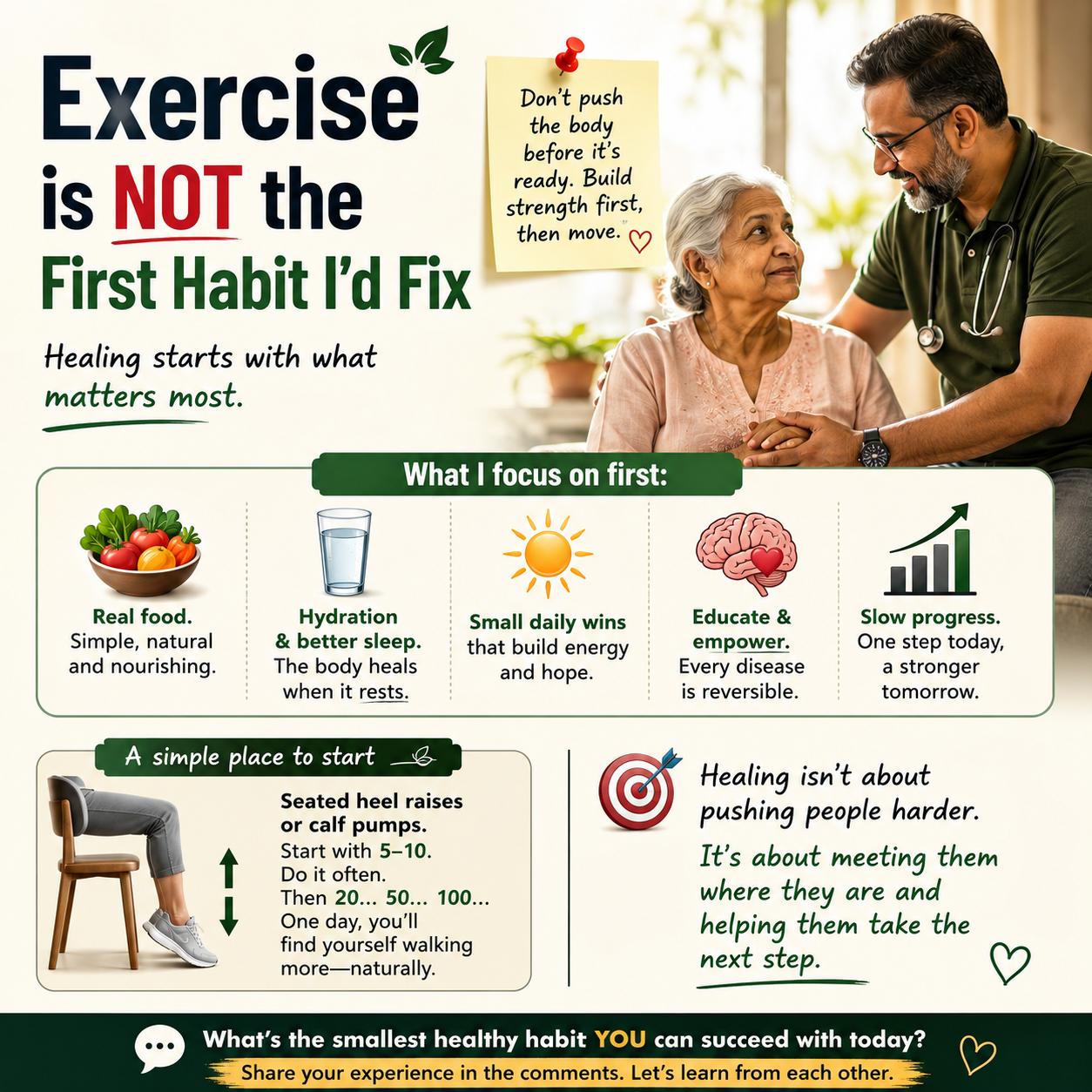
That's why exercise is rarely the first habit I'd fix.
I would start with food. Work on their nutrition. Get the good stuff into their body. Remove the ones that are the bad for them. Get them to drink more water. Get them to rest and recuperate.
When people begin to feel better, then exercise becomes something they want to do.
Sometimes the first exercise doesn't even involve standing up.
I often suggest seated heel raises or calf pumps.
Start with whatever they are comfortable with. Then increase it as they are able. Do them whenever they remember. Then twenty. Then fifty.
Suddenly one day they will be up and walking. Not because they were forced to. But because their body is finally ready.
Healing isn't about pushing people harder. It's about meeting them where they are... and helping them take the next step.
So if you are a caregiver, a health professional or just a concerned party, pause and ask yourself. If I were in this same position what would I do? What would I expect from others? Then the answer will present itself to you.
The question isn't "How much exercise should one do?"
But instead, "What's the smallest healthy habit that one can start with today?"
That one question can change everything.
Dr. Francisco Noronha
I help people reverse chronic disease by changing the environment in which disease develops—using homoeopathy, nutrition, lifestyle, and mindset together.
Disclaimer:
This article is intended for educational and informational purposes only and should not be considered medical advice. Every individual is unique, and recovery from illness, surgery, or chronic disease varies from person to person.


No comments:
Post a Comment