
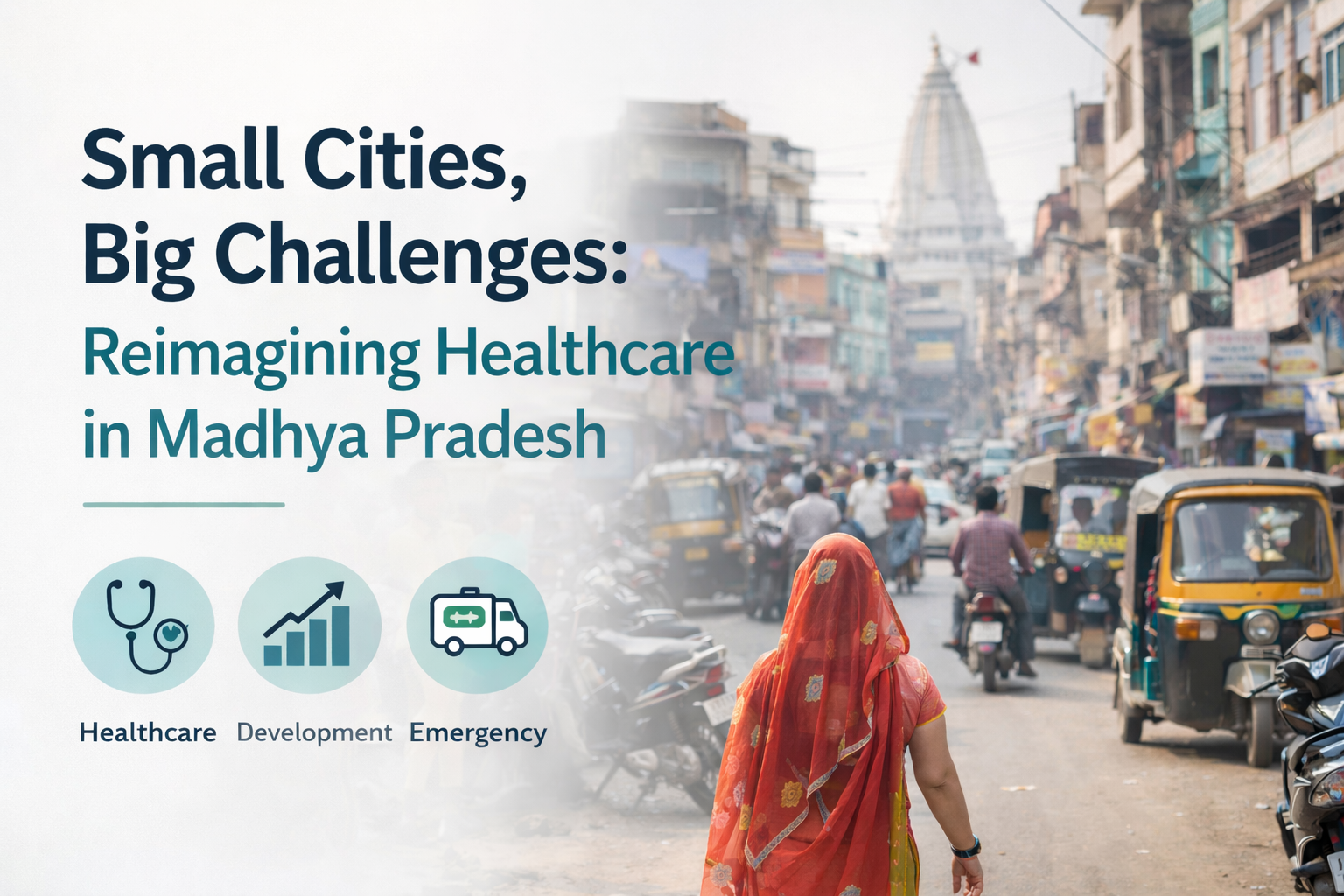
India’s healthcare journey tells a story of progress, hope, and innovation, but also of silent gaps that often go unnoticed. While metropolitan skylines glow with state-of-the-art hospitals and advanced therapies, a contrasting reality unfolds beyond their borders. In smaller towns, accessing healthcare can still feel like a long, uncertain, and sometimes overwhelming journey.
In Madhya Pradesh, this disparity is deeply visible. On one side, developed cities such as Jabalpur, Bhopal, and Indore are stepping into the future with digital healthcare tools, online consultations, and tech-driven solutions. On the other hand, many smaller cities, such as Sagar, Satana, Rewa, Raipur, Gwalior, and Ujjain, as well as semi-urban areas, continue to face challenges related to access, affordability, awareness, and service quality.
The digital healthcare wave is reaching many areas, but not at the same speed everywhere. As this transformation progresses, smaller cities are gradually becoming part of the digital shift, though adoption and impact vary widely. In this evolving landscape, digital healthcare is becoming a significant solution, bridging geographical gaps, improving accessibility, and reshaping how care is delivered.
Madhya Pradesh (M.P.), among India's largest states, is home to about 86.6 million people, roughly 6.2% of the national population.[1]
Despite progress in urban centres, the differences in healthcare access between cities and smaller towns remain significant, highlighting the need for more inclusive and balanced development.
Key barriers in smaller cities
-
Limited Healthcare Infrastructure
In the state, 40 to 50 thousand people are served by only one Primary Health Centre (PHC), and Community Health Centres (CHCs) serve nearly two lakh people.[2]
This is creating huge pressure on the healthcare system, and the infrastructure is getting overburdened. In smaller cities like Mandla, Dindori, and Barwani, the healthcare facilities are not well-equipped, and the infrastructure is lacking.
-
Shortage of Healthcare professionals and Specialists
The critical shortage of medical professionals remains a pressing problem. Many sanctioned posts are vacant, as doctors prefer urban centres for better infrastructure and career growth. This imbalance leads to delayed diagnoses, inadequate treatment, and frequent referrals to larger cities, burdening both patients and urban healthcare systems.
-
Lack of Awareness and Preventive Care
Preventive care and lack of awareness continue to be major issues in rural and smaller communities. Low health literacy, insufficient screening facilities, cultural prejudices, and a lack of awareness programs hamper early detection and prevention. As a result, many conditions go unnoticed until advanced stages, underscoring the urgent need for stronger awareness initiatives and early intervention strategies.
-
Financial Constraints and Out-of-Pocket Expenditure
Healthcare in smaller cities often comes with a significant financial burden. Even a basic consultation with a specialist, the required tests and medicines can result in an expenditure of 8-9% of the family’s monthly income.[3]
The rise of digital care in smaller cities
Amid these challenges, digital healthcare is emerging as a game-changer in the smaller cities of M.P.
-
Digital dispensaries and tele‑consultation hubs
Digital dispensaries are small health centres that use technology to connect patients with doctors in bigger cities. They have basic facilities like consultation rooms, test labs, and internet-enabled devices for video calls with specialists. In Madhya Pradesh, this model was tested in four districts with support from the Apollo Telemedicine Networking Foundation and the World Economic Forum under the EDISON Alliance.[3]
From March 2022 to June 2023, these centres provided over 13,975 general doctor consultations, 1,662 specialist video consultations, and conducted more than 7,000 lab tests, reaching people across nearly 200 villages and nearby small towns. Notably, around 59% of the patients were women, indicating improved access for those who often face travel and social barriers to healthcare. In addition, these centres reduced the average cost per patient to less than six dollars, making healthcare more affordable and accessible for marginalised regions.[3]
-
Data‑driven primary‑care platforms
Along with tele-consultation centres, the government is also improving digital health systems at the primary level. The MP-HSSP (Madhya Pradesh Health System Strengthening Project), a Tata Trust-supported initiative, is helping to digitise patient records in some urban health centres.[4]
For instance, the M‑UPHC (Mathpurena Urban Primary Health Care Centre) in Sagar uses the CPHC NCD (Comprehensive Primary Health Care Non-Communicable Disease) platform, a simple mobile-based system, to record and track diseases like diabetes and high blood pressure among people above 30. This makes record-keeping easier, helps doctors refer patients on time, and supports better decisions at the district level.[4]
If a patient loses a prescription or misses a follow-up, doctors can easily check their records online. This ensures proper treatment and continuity of care, which was very difficult with paper records.
Challenges in Digital Healthcare Adoption
The expansion of digital healthcare in smaller cities faces many practical and policy-level challenges.
-
Digital Divide and Trust Barriers
In many semi-urban areas, internet access and device availability are still uneven. Older people, women in conservative families, and low-income groups may not have smartphones or feel comfortable using video consultations. Even where digital services are available, patients often trust in-person visits, especially for serious or sensitive health issues.
-
Data Privacy and Security Concerns
Handling patient information requires strong cybersecurity measures. Without proper protection, there is a risk of data breaches, misuse, or hacking. This can harm patients and reduce trust in digital healthcare. So, secure systems are essential to protect privacy and ensure people feel confident using digital health services.
Opportunities and the Way Forward
-
Strengthening Public Infrastructure
Stronger public infrastructure can significantly boost healthcare outcomes in smaller towns and villages. Upgrading PHCs and CHCs improves service quality and patient care. Ensuring the availability of essential medicines and proper equipment helps build trust, reduces treatment delays, and supports timely, effective healthcare for all communities.
-
Addressing Workforce Shortages
Addressing workforce shortages is essential for fair healthcare access. Encouraging doctors to practice in smaller cities can increase the availability of medical services. Expanding telemedicine support allows for specialist consultations from a distance. This reduces the pressure on limited staff and ensures patients receive timely, expert care without having to travel far.
-
Expanding Digital Health Solutions
An increase in digital healthcare initiatives is key to improving access to healthcare among the poor population. The expansion of digital dispensaries will assist in improving access to medicines and consultations. Improved connectivity ensures smooth service delivery, whereas the training of health practitioners in digital platforms ensures that they offer quality technology-based health care.
Final Verdict
Healthcare in the smaller cities of Madhya Pradesh stands at a critical juncture. Problems like weak infrastructure, fewer doctors, and financial issues still exist. However, digital healthcare is creating new hope. Services like telemedicine, digital dispensaries, and mobile health units are helping people access better care. Still, problems like poor internet, low digital knowledge, and limited facilities need improvement. With strong government support, better technology, and community involvement, Madhya Pradesh can create a fair healthcare system where everyone receives good treatment, no matter where they live.
Literature cited
[1] NITI Aayog. Summary Report for the State of Madhya Pradesh. New Delhi: Government of India; Available from: https://niti.gov.in/sites/default/files/2025-07/Summary-Report-Madhya-Pradesh%20%281%29.pdf
[2] Sharma S. Assessment of infrastructure and manpower in public health facilities in Madhya Pradesh: Spatial dimension. Trans Inst Indian Geographers. 2024; Available from: https://www.academia.edu/104557853/Assessment_of_infrastructure_and_manpower_in_public_health_facilities_in_Madhya_Pradesh_Spatial_dimension
[3] Sethi V, Premanand S, Meng L. How digital dispensaries are helping rural communities in Madhya Pradesh. World Economic Forum. 2025. Available from:https://www.weforum.org/stories/2023/08/digital-dispensaries-madhya-pradesh-healthcare/?utm_source=chatgpt.com
[4] Collectives for Integrated Livelihood Initiatives. From paper to progress: how digital healthcare is transforming lives. 2024. Available from: https://cinicell.org/our-stories/from-paper-to-progress-how-digital-healthcare-is-transforming-lives/


No comments:
Post a Comment