
Source: Perplexity
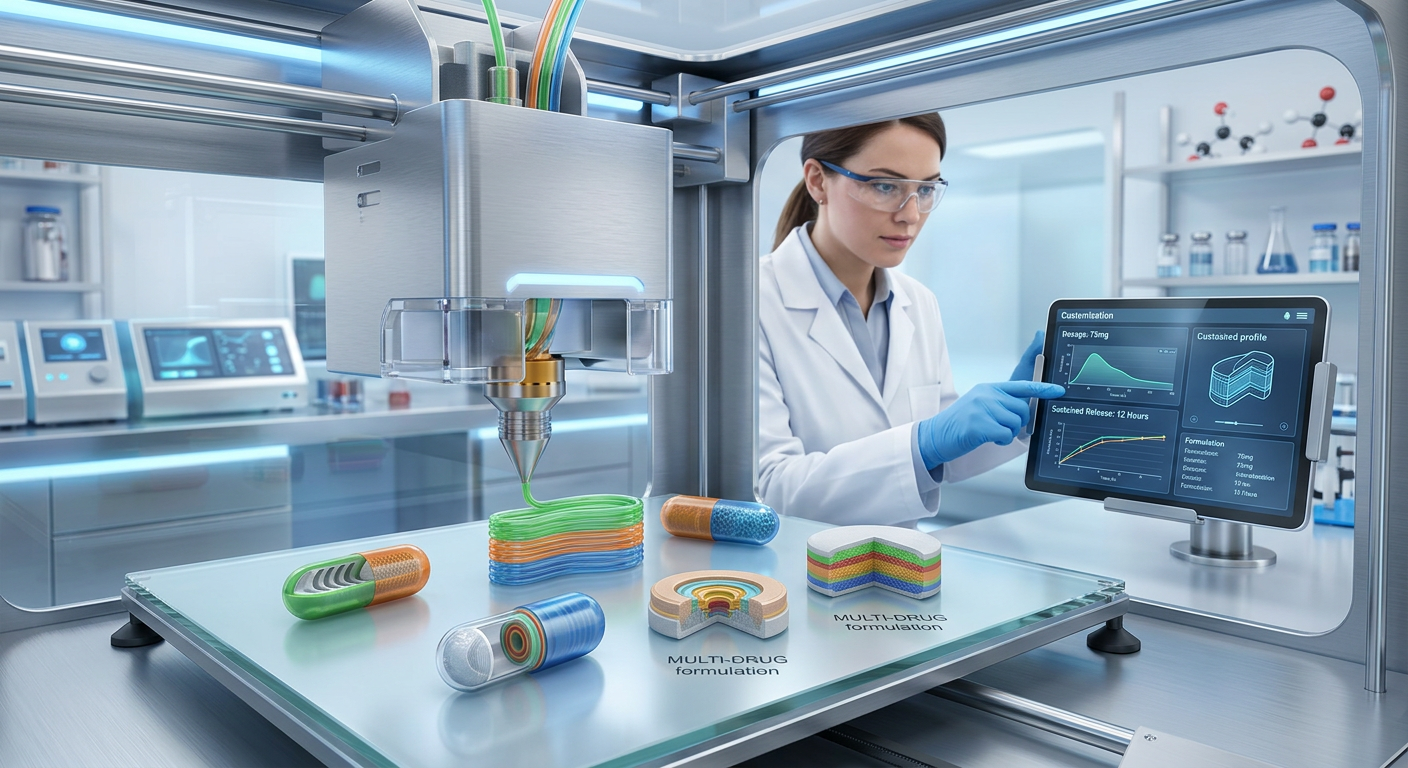
Imagine a scenario in a hospital pharmacy where drugs are no longer “one size fits all”. Instead, a patient receives a medicine customised to their age, weight, genetic profile, and current therapy. The medicine is built layer by layer so that it releases the drug at the right time and in the right amount for the patient. This example shows the potential of three-dimensional (3D) printing in pharmaceuticals.
It is an additive manufacturing technique that aims to shift pharmaceutical manufacturing away from large-scale, uniform production and towards highly personalised, on-demand therapy.
Understanding 3D printing of medicines
The ISO (International Organisation for Standardisation) describes 3D printing of medicines as a process in which material is deposited layer by layer using printer technology to create a final product.
This method focuses on creating personalised healthcare solutions. These include customised medicines, advanced medical devices, and surgical models based on unique patient profiles. These applications are useful for surgery planning, education, and implants, but they also require strong quality control and regulatory guidelines.
-
Method of 3D Printing in Pharmaceutical Manufacturing
The process of creating a 3D-printed medicine begins with preparing the active pharmaceutical ingredient (API) and excipients in a printable form, such as powder, liquid, or filament. The dosage form is then digitally designed using advanced computer software, which is usually tailored to the patient's dose or demand.
The 3D printer then deposits the material layer by layer based on the digital design. Through this controlled process, the medicine is built gradually until the final structure is formed. Depending on the procedure, the end product is either dried, solidified, or hardened after printing. Finally, quality checks are conducted to ensure proper dosage, potency, and safety.
Global Foundations and Approved Drugs
The field of 3D-printed medicines gained global recognition when the FDA approved Spritam, a levetiracetam-based antiepileptic drug, in 2015. Since then, several companies have started exploring this technology. For example, Triastek, a Chinese company, received Investigational New Drug (IND) designation for T19, a medication for rheumatoid arthritis. Meanwhile, startups like FabRx and Craft Health are developing technologies to design polypills and colon-targeted dosage forms.
-
Current Landscape in India
India's pharmaceutical industry, the world's largest producer of generic medicines, stands to benefit from this shift towards 3D-printed medicines.
In 2022, the Indian Institute of Science (IISc) in Bengaluru established India’s first 3D Bioprinting Centre of Excellence in collaboration with CELLINK to enhance drug discovery and personalised treatment strategies.
In 2025, researchers at NIT Rourkela successfully created a distinctive bio-ink that mimics bone, formulated from chitosan and nanohydroxyapatite. This innovation has been patented for the repair of bone defects, and animal testing is anticipated.
Indian startups, like Avay Biosciences, are developing bioprinters to create tissue models for drug testing, which may help reduce the dependence on animal experiments.
Despite these developments, no 3D-printed drug has yet received approval from CDSCO (Central Drugs Standard Control Organisation) for large-scale use in India.
The regulatory landscape, governed by the Drugs and Cosmetics Act 1940, has recognised 3D-printed items since 2020 but lacks specific guidelines, resulting in ambiguity. Companies face challenges in proving compliance with biocompatibility and sterility while aligning with international standards.
Barriers to Adoption
In India, 3D-printing of medicines faces several challenges. First, high equipment costs and a shortage of trained professionals make implementation difficult. Although on-demand printing has the potential to help reduce the problem of counterfeit drugs, there are concerns about material safety and compatibility with APIs (active pharmaceutical ingredients). The heat used in the printing process can reduce the efficacy of medicines.
Regulatory gaps further slow down the approval and sales of 3D-printed medicine compared to developed markets. Another challenge is India’s genetically diverse population, which requires extensive testing and validation to prevent possible adverse drug reactions.
Future Possibilities and Opportunities
Despite these challenges, 3D printing has the potential to enhance healthcare in India significantly. It helps in the development of customised doses, reducing medicine waste, which is critical for India's generic drug industry.
Furthermore, pharmacies in remote areas can print medicines on-site, which reduces the need for long supply chains. Bioprinting may assist in creating tissue models for rapid and less expensive drug testing. Government efforts such as “Make in India” and financing for health research help to drive this growth. If guidelines are clear and strong, the industry might expand rapidly.
Conclusion
3D-printed medicines are more than just a technology advancement; they represent an important shift in patient care. For India, this is an opportunity to move beyond being the “pharmacy of the world” and become an innovator in customised treatment. If India responds effectively, 3D printing has the potential to transform the future of Indian pharmaceuticals, one personalised tablet at a time.
References
1. Wang S, Chen X, Han X, Hong X, Li X, Zhang H, Li M, Wang Z, Zheng A. A review of 3D printing technology in pharmaceutics: technology and applications, now and future.Pharmaceutics.2023,15(2):416. doi: 10.3390/pharmaceutics15020416
2. Kumari J, Pandey S, Jangde KK, Kumar PV, Mishra DK. Evolution, integration, and challenges of 3D printing in pharmaceutical applications: a comprehensive review. Bioprinting.2024,44:e00367.doi: https://doi.org/10.1016/j.bprint.2024.e00367
3. Lalitha KA, Raghava D, Nageswara Rao K, Naga Sravani P. Regulatory hurdles in the commercialisation of 3D printed pharmaceuticals and medical devices—Journal of Cardiovascular Diseases Research. 2025,16(10):138. https://www.jcdronline.org/index.php/JCDR/article/download/14529/8119/15783
4. Prajapati D, Tandel D, Patel D, Thakker D. Global regulatory landscape for 3D printed medical devices: challenges, standards, and compliance pathways.International Journal of Creative Research Thoughts (IJCRT). 2025,13(11):743-755. https://www.ijcrt.org/papers/IJCRT2511452.pdf
5. Khanna A. Regulations for 3D printing.Gateway House, Indian Council of Global Relations. 2020. https://www.gatewayhouse.in/regulations-3d-printing/


No comments:
Post a Comment