
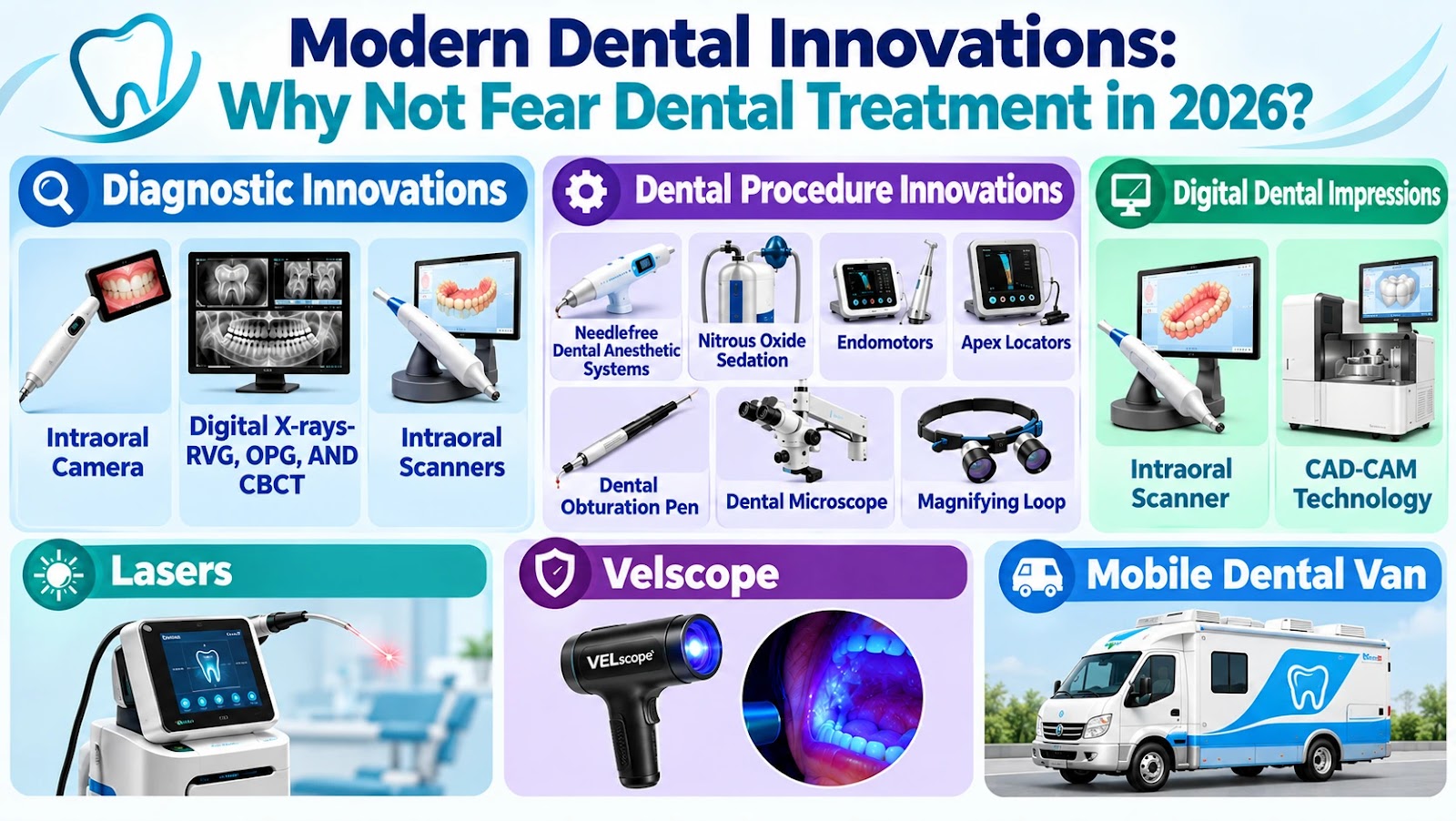
Are you ignoring dental treatment just because of the fear and anxiety related to it? Let’s go on a field trip to modern dental innovations that have made many dental procedures comfortable for patients.
Still imagining a dental visit as a scary experience? But, that’s not the reality of today’s dentistry. With advancements in technology, dental procedures have become easy for both the patients as well as dentists.
From simple clinical examinations to complex implant surgery, dentistry has evolved significantly with the help of modern technology.
Modern dentistry is more focused on relieving stress and anxiety related to dental procedures.
Modern Dental Innovations For Clinical Examinations
Diagnosing dental problems has become more accurate with the use of digital technology. Modern dental innovations including intraoral cameras, digital dental X-rays, and intraoral scanners are valuable diagnostic tools used in 2026.
Some of the dental clinics may also have in-house OPG (Orthopantomogram) and/or 3-dimentional (3D) X-ray CBCT (Cone Beam Computed Tomography) facilities. These can be more convenient to patients as all the diagnostic x-rays can be performed at the clinic itself.
Intraoral Cameras-A Useful Tool in Patient Education
A person will believe what he can actually see, right? The use of intraoral cameras in clinical examinations is very helpful in educating the patients about their own oral health.
A visual image of a mouth with multiple decayed teeth and inflamed gums may help encourage a person to seek dental care. Also the before-and-after images clicked through intraoral cameras may help explain how a particular dental treatment has addressed the problem.
Digital Dental X-rays, OPG, and CBCT
Gone are the days when dentists were using conventional films to capture the X-rays. Digital intraoral radiographs- RVG (Radiovisiography), are one of the most useful tools for dental diagnosis.
Radiographs are important diagnostic tools in dentistry. Digital radiography allows the capture of multiple X-rays of the teeth with potential reduction of radiation exposure, better quality and more speed.
For implant dentistry, treatment of malaligned teeth, or treatment for multiple teeth in-house facilities of OPG and/or CBCT can reduce the patient inconvenience of visiting imaging centers separately.
CBCT plays an important role in implant planning, diagnosing complex tooth anatomies (For selected cases of root canal treatment), and planning certain dental surgeries.
Intraoral Scanners for Making Diagnostic Models
Intraoral scanners are very useful assets to take digital impressions of a patient's mouth that can be used to make 3D models. These diagnostic models can be used for treatment planning, including implants and malaligned teeth in orthodontics.
Thus, modern dental innovations make clinical examinations more accurate and less messy for patients.
Modern Dental Innovations To Reduce the Fear During Dental Procedures
From children to adults, many people are afraid of needles. Many of the dental procedures require administration of local anesthesia for comfortable and painless treatment. These include root canal treatment (RCT), tooth removal, implant placement, periodontal surgery and others.
Modern dentistry has developed certain techniques to help dental anxiety and needle phobia. Needlefree dental jet injections and nitrous oxide sedation are two approaches that may be useful in selected cases.
Use of Needle Free Dental Anesthesia
Conventional techniques involve use of needles to deliver dental anesthesia. Certain needle free dental anesthesia systems are available nowadays that can provide effective anesthesia and eliminate the pain of needle prick.
Thus, do not fear and avoid dental treatments because of fear of needles or injections. Modern dentistry continues to evolve to make the treatment less painful and comfortable for patients.
Use of Nitrous Oxide Sedation
Nitrous oxide sedation has been used in dentistry for years to relieve anxiety and fear. It can be particularly useful for dental procedures in uncooperative children, anxious patients, medically compromised patients, and old age people.
They are effective in reducing pain and also increases the effect of local anesthetic agents.
In addition to this, advanced dental instruments such as endomotor, apex locator, electric obturation system, dental magnifying loops, dental microscope etc. have helped reduce the treatment duration considerably with improved treatment outcome for certain procedures.
Digital Dental Impressions Using intraoral scanners
I still remember an incident from my college days. One patient ran out of the dental operatory after feeling a strong gag reflex followed by vomiting during the impression- taking procedure for her crown.
Many people have a strong gag reflex and taking dental impressions in them is a difficult task for both the dentists as well as the patients. There are several ways to manage such patients, including use of medications to prevent the gag reflex and behavioral techniques.
However, modern dentistry has made this procedure much simpler. Without placing conventional impression materials in a patient’s mouth, the intraoral scanner captures detailed images of the teeth and gums. Thus, it creates a 3D image of the patient’s mouth precisely.
Dental laboratories can use these digital impressions to print the 3D models from them and complete the dental lab work (making crown, bridges etc).
Thus, intraoral scanners can eliminate the need for conventional messy dental impressions and increase the efficiency of dental laboratory workflow.
Modern Dental Innovations in Cosmetic Dentistry
A beautiful smile can create a positive first impression. Modern dentistry offers several options for many of your aesthetic concerns with more accuracy and less discomfort.
From space between your teeth to gummy smile, there are multiple treatment options depending on the patient’s needs.
Use of porcelain veneers, composite restorations, metal free dental crowns, professional teeth whitening using light emitting diodes (LED), and laser technology have contributed to make cosmetic dentistry more effective.
-
Porcelain Veneers
Modern computer-aided design and computer aided manufacturing (CAD-CAM)technology, digital dental impressions, and advanced dental materials may help dentists design and fabricate veneers that will provide you a natural looking beautiful smile.
-
Composite Restorations
Composite resin restorations are tooth-coloured restorative materials. They have been used in dentistry for many years. Their properties and qualities are being improved year by year.
With the latest composite resins and advanced restorative techniques, it is possible to restore cavities with excellent aesthetics.
-
Metal Free Dental Crowns
Zirconia crowns known as metal free crowns can provide better translucency, strength, shade matching and biocompatibility.
It is possible to make dental crowns that are not easy to differentiate from natural teeth due to advanced technology and improved materials.
-
Teeth Whitening Using LED
In modern dentistry, teeth-whitening can be done by applying the whitening materials and use of LED lights.
Depending on the material used, its concentration, and individual patient factors, results of professional teeth whitening may vary.
-
Lasers in Dentistry
Lasers are useful for certain procedures in dentistry including periodontal gum surgeries, gum reshaping, crown-lengthening, caries removal, teeth whitening and treatment of precancerous lesions etc.
Laser dentistry may help perform the soft tissue surgeries with minimal bleeding compared to conventional techniques. It also helps reduce postoperative discomfort and improve healing.
Velscope- A modern Dental Innovation That Helps Detect Oral Cancer
Dentists play an important role in detection of oral cancers. Early detection of oral cancer is an important factor in increasing the survival rates of oral cancer patients. Conventional oral examination remains an essential part of diagnosing oral suspicious lesions.
However, a new non-invasive diagnostic tool- velscope can be used as an adjunct to identify areas of abnormal oral tissues. It uses autofluorescence visualization to detect the cellular changes presenting cancer, in high risk patients.
It cannot replace the conventional oral examination or histopathological examination of a biopsy specimen for a definitive diagnosis. However, it may help guide practitioners to identify the appropriate areas for biopsy.
Mobile Dental Clinics
Although the dentist-to-population ratio in India has improved a lot, the majority 80% of the dentists serve the urban population.
Mobile dental clinics are one of the modern dental innovations that try to provide dental care to underserved rural populations.
These dental clinics on wheels provide dental services to patients in remote villages, urban slum areas, educational institutes and community sites.
Other innovative approaches include suitcase dentistry, which uses portable dental equipment to provide several dental treatments at your doorstep without visiting a dental clinic. This is very useful to elderly populations and physically disabled people.
Thus, modern dentistry is making every possible effort to make oral healthcare accessible to everyone.
Conclusion:
Thus, from diagnosis to treatment, modern dental innovations have made many dental procedures simpler, predictable, and less problematic for patients.
From needle-free anesthetic techniques to mess-free digital impressions, technological advancement is trying to solve many concerns related to dental treatments.
Therefore, anxiety and fear should not be the reasons for ignoring dental problems in 2026.
Also, preventive dentistry costs you much less than later treating the same tooth for complex procedures or getting the artificial one to replace it.
References:
-
Venkatesh E, Elluru SV. Cone beam computed tomography: basics and applications in dentistry. J Istanb Univ Fac Dent. 2017;51(3 Suppl 1):S102-S121. Published 2017 Dec 2. doi:10.17096/jiufd.00289
-
Dhull KS, Nagar R, Mathur P, et al. Intraoral Scanners: Mechanism, Applications, Advantages, and Limitations. J Pharm Bioallied Sci. 2024;16(Suppl 3):S1929-S1931. doi:10.4103/jpbs.jpbs_1299_23
-
Belevcikli M, Altan H, Demir O. Effect of the new needle-free injection system on pain perception and dental anxiety during anesthesia: randomized controlled split-mouth study. J Dent Anesth Pain Med. 2023;23(1):1-8. doi:10.17245/jdapm.2023.23.1.1
-
Khinda V, Rao D, Sodhi SPS. Nitrous Oxide Inhalation Sedation Rapid Analgesia in Dentistry: An Overview of Technique, Objectives, Indications, Advantages, Monitoring, and Safety Profile. Int J Clin Pediatr Dent. 2023;16(1):131-138. doi:10.5005/jp-journals-10005-1807
-
Sachelarie L, Cristea R, Burlui E, Hurjui LL. Laser Technology in Dentistry: From Clinical Applications to Future Innovations. Dent J (Basel). 2024;12(12):420. Published 2024 Dec 23. doi:10.3390/dj12120420
-
Shah S, Waknis P, Saha A, Setiya S, Ratra T, Vaswani V. The use of Velscope to assess cellular changes occuring in oral premalignancy. J Oral Biol Craniofac Res. 2020;10(2):99-103. doi:10.1016/j.jobcr.2020.03.004
-
Vibhute NA, Jagtap SV, Patil SV. Velscope guided oral cancer screening: A ray of hope in early oral cancer diagnosis. J Oral Maxillofac Pathol. 2021;25(3):548-549. doi:10.4103/jomfp.JOMFP_315_20
-
Kshirsagar M, Dodamani A, Pimpale S, et al. Mobile Dental Clinics: Bringing Smiles on Wheels. Cureus. 2025;17(5):e83873. Published 2025 May 11. doi:10.7759/cureus.83873
Disclaimer:
The information provided in this article is for educational purposes only and can not replace professional dental advice, diagnosis, or treatment. Always consult a qualified dental professional regarding any concerns related to oral health.
About the Author:
Dr. Zankhana Shah is a dentist with 10 years of experience in clinical dentistry. She has special interest in medical writing and likes to write educational articles on different topics related to healthcare. She enjoys creating educational content on recent advances in dentistry to help people aware about the oral health.


No comments:
Post a Comment