
Do you remember the excitement of getting your favourite meal when you were in school but have already forgotten what you had for breakfast yesterday? Why do you remember certain things but forget some other things? Everything we see, hear, feel, or experience is processed by the brain and stored as memory. Memory allows the brain to learn, recognise, recall, and use information when needed. So let's understand how the brain store memories and why some experiences stay with us while others fade.
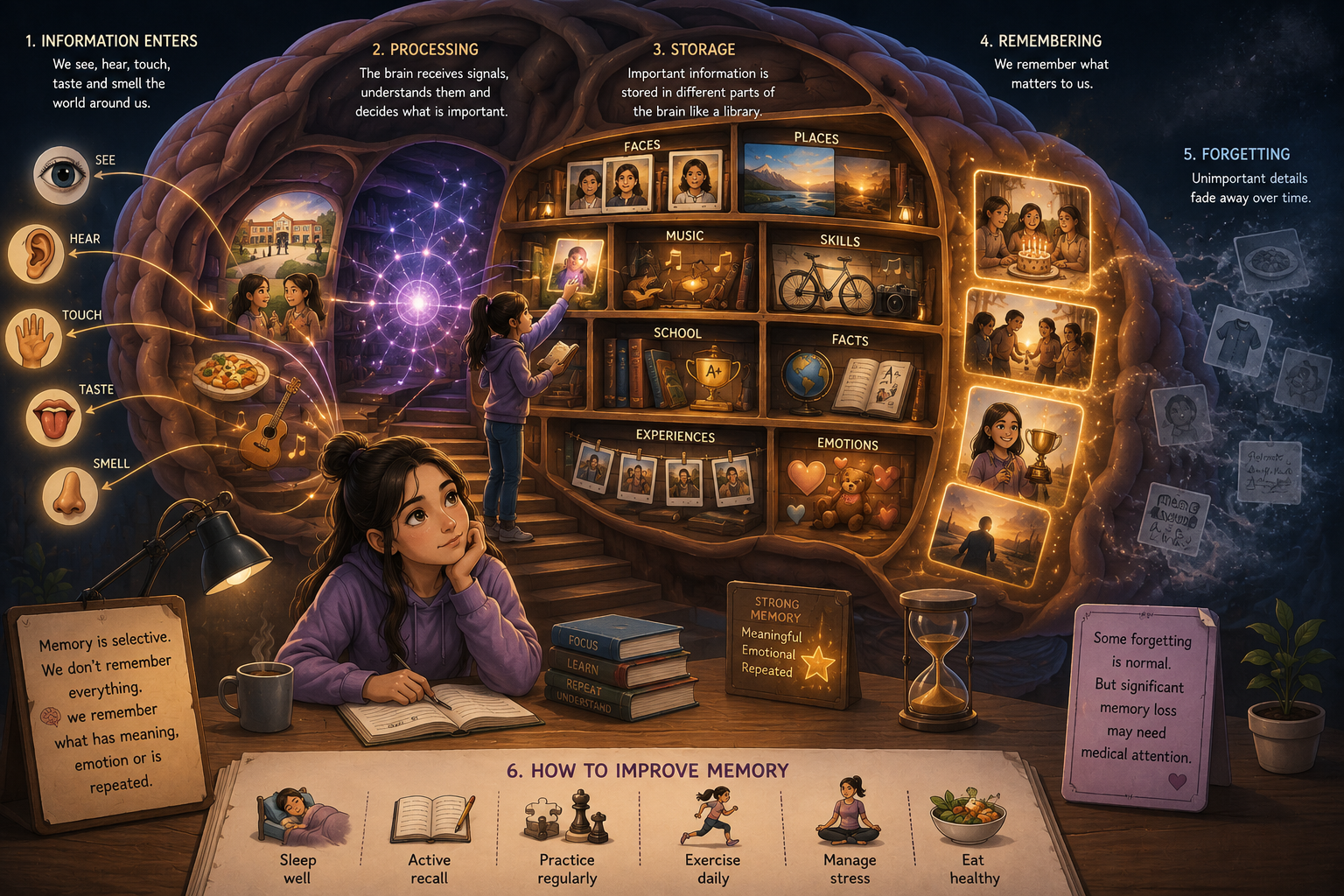
How does the Brain store Memories?
Imagine you have a piece of information to share it with your friend. First, you think about the best way to share it. You may choose either a conversation or any digital method.
Similarly, that's the way our brain works. We learn and process information through our eyes, ears, nose, and other senses. This information is carried through the tiny cells, almost like the messenger cells, towards the brain. The brain receives these signals, just like the notifications that appear on the screen, and processes them.
Just like different folders on our phone, our brain has different regions that can process information and store it safely in those specific regions for later use.
How does the Brain organise Memories?
Let's consider the folder on our phone. Different types of data are properly sorted and labelled. So in the future, we can just search for that particular data and find it. For example, an image folder which contains different images like screenshots, downloaded pictures, camera photos, edited images and more
In a similar way, our brain processes and works on information. Once the brain gets the information, it processes and stores the information in specific areas. This process helps the brain store memories in ways that can be used later.
For example, imagine you meet a new person. Your eyes capture information about that person and send it to the brain via messenger cells. The brain processes the information and helps to recognise the person later. This is happening continuously during studying, conversations, and other activities. The brain constantly processes new information and makes it available for the future.
Why do we Remember some Things and Forget Others?
Still remember those days, the excitement of a full score in front of the whole class, yet struggle to remember what you did last week?
Think about how we refresh our phones and clear unnecessary data for smooth running. Similarly, our brain also processes and collects information every moment. The way our brain store memories is influenced by attention, emotion, and meaning.
Every day, our brain constantly receives information. Less information is not retained. This can include things like wearing casual outfits for an ordinary day or daily food routines. However, you may wonder how you remember the birthday dress you wore and the food you had in the restaurant? The difference is in the importance of meaning. Experiences of strong emotions, important events, learning, or focused moments are more strongly made into memories. This can include moments like happy ones, sad experiences, excitement, threats, or events that require us to protect ourselves.
Not everything that we experience becomes a lasting memory. The brain constantly processes information, choosing meaningful or useful information to remember.
Why are Some Memories Stronger Than Others?
You may have different versions of phones over the years, but your first phone always has a special place in memory. In the same way, even some moments hold a special place in our brains.
Remember the surprise on your birthday, those emotions you felt when your parents scolded you, and the fear when your teacher found out that you missed your homework. These are not just ordinary memories. They are also a living experience, connected with strong emotions, making them memorable. This helps explain how the brain store memories linked to important experiences.
Some experiences become a source of lasting memory. They would have changed something within you, either the way you think, behave, or react to similar situations. In this way, a memory can become more than something we remember. A life lesson
How can you Improve Your Memory?
A few simple habits can support your memory.
-
Sleep well
-
Use active recall
-
Reduce unnecessary screen time
-
Engage in outdoor activities
-
Stay hydrated and eat balanced meals
-
Learn new skills
-
Take short breaks
-
Repeat information over time
-
Always track stress level
Conclusion
From remembering an important school day to forgetting what we had for breakfast, our memory works in interesting ways every day. Our brain constantly processes information. It prioritises information that seems useful, meaningful, or important. It also connects. strengthens while ordinary details fade. Understanding how the brain store memories works can help us understand ourselves better and make simple changes to remember what truly matters.
Key Takeaway
-
Memory is selective and meaning-driven.
-
Sleep and practice strengthen memory.
-
Forgetting is normal.
-
Unusual memory loss may need attention.
Disclaimer
This article is for general educational purposes only and does not replace professional medical advice, diagnosis, or treatment. If you experience persistent, severe, or concerning symptoms, consult a qualified healthcare professional.
Reference
How does the brain work? : https://scienceexchange.caltech.edu/topics/neuroscience/how-the-brain-works
Brain Facts: https://www.brainfacts.org/thinking-sensing-and-behaving/learning-and-memory/2023/how-does-the-brain-learn-101923
Improve your memory: https://www.mayoclinic.org/healthy-lifestyle/healthy-aging/in-depth/memory-loss/art-20046518
About the Author
Priya Varshini S is a biotechnology graduate with a passion for research, lifelong learning, and content writing. They enjoy exploring diverse topics, continuously learning, and transforming ideas into clear, engaging, and reader-friendly content.
Thank you for reading!


No comments:
Post a Comment