
A Small Thought, A Big Heart
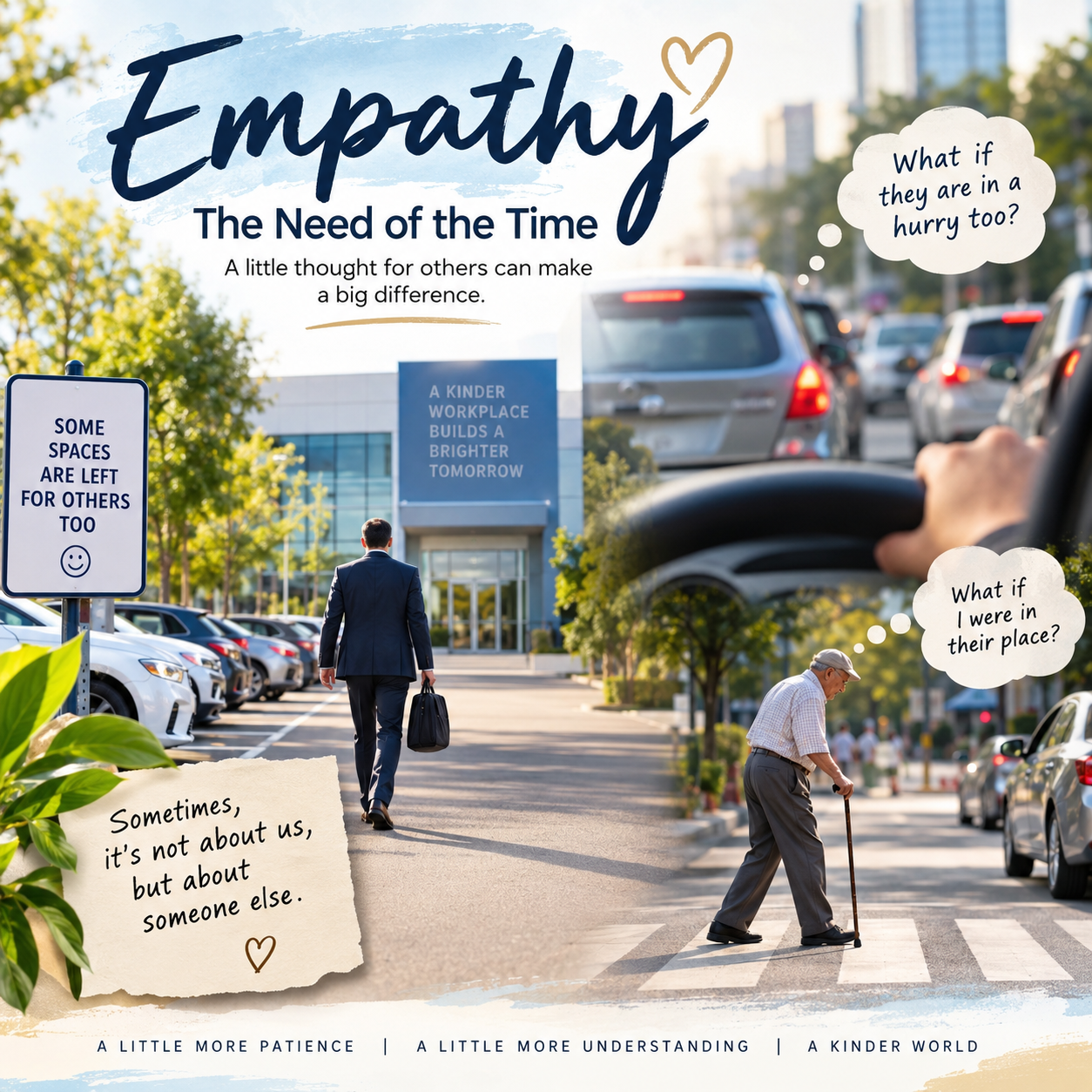
I am reminded of a story I read online. An Indian goes to Switzerland on an assignment with his firm. On his first day, the person driving him to the office parks at the far end of the parking lot and walks all the way to the entrance. The Indian, surprised, asks him, “Why did you park so far away?” The person replies that he wanted to leave the spaces closer to the entrance for those who arrived later or just in time. If they had to park farther away, they would have to walk more, making them even later to work.
A small thought, but it carried a big heart.
The person was not thinking about where it would be most convenient for him to park. He was thinking about the person who would come after him. He was thinking of someone else.
And perhaps that is something we are slowly losing. We are increasingly thinking about ourselves. We are so occupied with getting where we want to go that we sometimes forget that everyone else is trying to get somewhere too.
Are We Thinking Only About Ourselves?
Take something as ordinary as driving to work. You are already running late. The traffic is heavy and suddenly, a car cuts in front of you. What is your immediate reaction? You get irritated. You honk hard and perhaps you swear loudly (if you are alone).
But let us, for a moment, look at it from the other side. Maybe the driver was in a hurry himself. Maybe he was rushing because of an emergency. We don't know.
Or take another familiar situation. You are waiting in line at the grocery store, and the elderly man in front of you moves so slowly and deliberately that you feel irritation rising and want to pass a sarcastic remark to the person behind you.
What If I Were in Their Place?
But again, can we put ourselves in his shoes. If you were that person at his age, would you be doing anything differently.
These two examples are not really about the person or situation you are facing. They are about how you react. Can I empathize with the person or situation?
Empathy is often described as the ability to understand or share another person's feelings. In everyday life, we find it in the simple things that come our way.
At home, we may get irritated when our children don't listen. At work, we may become impatient when a colleague doesn't finish something as quickly as we expected. At the bank, we may get annoyed when the person at the counter takes too long.
In each situation, we are only thinking about ourself. How is this affecting me? How much time am I losing? Why is this person inconveniencing me? Why can't they behave the way I expect them to?
Perhaps the question we need to ask more often is: “What if I were in their place?” “What might be happening on their side?”
I have personally found that it is not easy at first. But you need to realize that our reaction is what determines our state of mind, our happiness and peace.
Our Reaction Affects Us
We have to realize that our reaction does not affect the other person. It affects us.
The driver who cut you off has driven away, but I am still seething about it.
The elderly man in front of you walks out of the store, but I am so upset that I narrate the incident to my friends and family in a derogatory way.
The situation has passed, but my reaction lasts beyond the situation.
Learning to Catch Our Reaction
So, what that means is that learning to change that reaction is the solution.
It is a conscious choice. One has to realize, “This is something that I want. I don’t want every little inconvenience to control my state of mind.”
But that does not change overnight.
I will still get upset, irritated, and lose my patience.
But each time, I can catch myself. I can pause and acknowledge what is happening. I can choose to respond differently.
This is something that I need to work on. I need to be alert, conscious, and aware to catch those reactions.
One Battle at a Time
Even if I slip, I have only lost the battle, but the war can still be won. And we will have many skirmishes before the war is done.
It also says that practice makes perfect.
The results, though, are worth the fight.
It is not just that we can control our reactions. Slowly, we find ourselves more at peace, more patient and happier. And is this not what the world is searching for?
The Need of the Hour
But now we have the answer. Empathy. That is what is needed in the hour.
So, good success in the days and times ahead, to a life full of thinking about others above ourselves.
Author:
Dr. Francisco Noronha


Nice article with a good thought!
ReplyDelete