

Medicines are a fundamental part of healthcare, and easy access to them plays a crucial role in maintaining the health of individuals and communities.
In a country like India, where a large population depends on affordable treatment options, both government initiatives and private pharmacies contribute significantly to the availability of medicine.
In Madhya Pradesh, which accounts for roughly 6% of India’s total population, people commonly obtain medicines from two main sources: government-supported pharmacies such as Pradhan Mantri Jan Aushadhi Kendra and privately owned pharmacies.
Recent data from 2025 highlights the growing pharmacy network in the region. Around 9,362 pharmacies have been mapped, mostly located in urban and commercial hubs. Cities like Indore (827 pharmacies), Bhopal (808), and Gwalior (671pharmacies) show a strong presence of retail medical stores.
In terms of ownership structure, the pharmacy sector is largely dominated by independent businesses. Nearly 97.78% of pharmacies operate as single-owner establishments, while only about 2.22% belong to organised or larger pharmacy chains.
Although both types of pharmacies aim to provide medicines to the public, they differ in several aspects, including pricing, availability, accessibility, and the range of services they offer.
Government Schemes Overview
Government pharmacy schemes in India aim to make medicines affordable and easily accessible to the public. One of the most significant initiatives is the Pradhan Mantri Bhartiya Janaushadhi Pariyojana (PMBJP). This programme was launched to promote the use of generic medicines through special outlets known as the Pradhan Mantri Jan Aushadhi Kendra, which provide medicines at prices much lower than branded drugs.
The medicines available at Jan Aushadhi Kendras are generic drugs. These medicines contain the same active ingredients and provide the same therapeutic effects as branded medicines. However, they are sold at much lower prices because they are not marketed under costly brand names. As a result, patients can often purchase these medicines at prices 40-60% lower than branded alternatives.
Despite these benefits, government pharmacies sometimes face challenges such as limited stock availability and fewer medicine options compared to private pharmacies.
Private Pharmacies Landscape
Private pharmacies are commonly found in both urban and rural areas of Madhya Pradesh. These pharmacies may operate as independent stores or as part of larger pharmacy chains. Private pharmacies typically stock a wide range of medicines from different pharmaceutical companies.
One major advantage of private pharmacies is their convenience. They often stock both branded and generic medicines, including products from different systems of medicine such as allopathy and Ayurveda. In addition, many private pharmacies remain open for longer hours and generally maintain better availability of essential medicines compared to many public health facilities.
Comparison Between Govt. and Private Pharmacies
-
Affordability Comparison
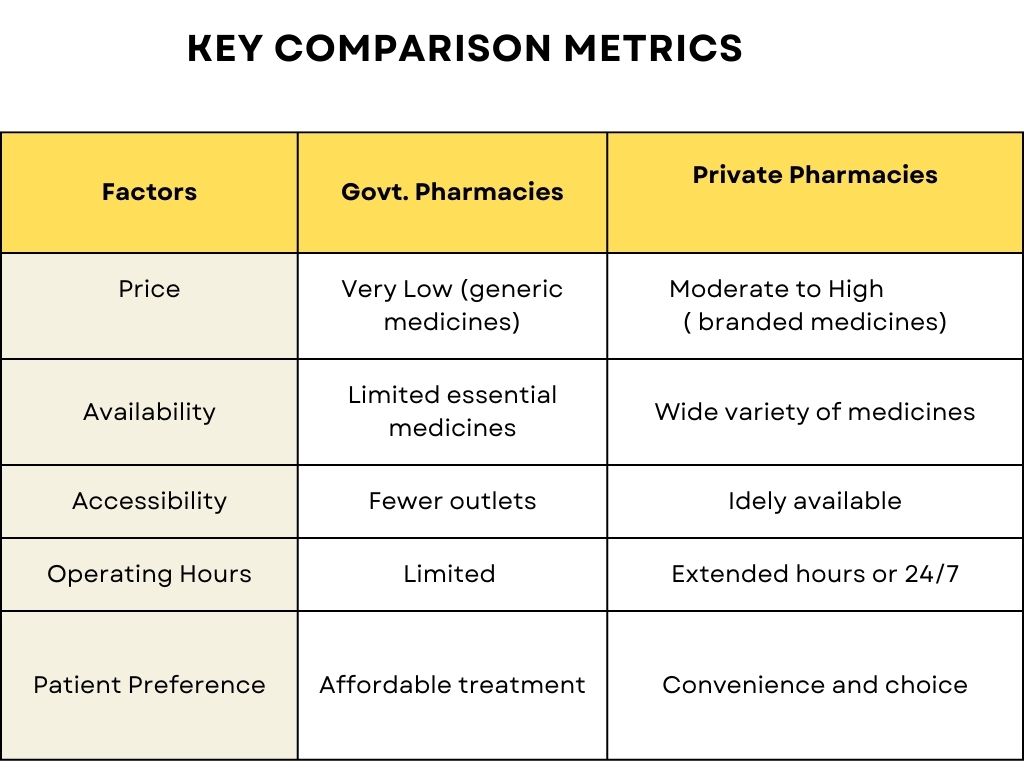
One of the most significant differences between government and private pharmacies lies in the prices of medicines. Medicines available at Jan Aushadhi Kendra are generally much cheaper because they are generic medicines supplied through a government initiative.
In contrast, private pharmacies usually sell branded medicines manufactured by pharmaceutical companies. Branded drugs are often more expensive due to marketing costs, brand value, and distribution expenses. Although many private pharmacies now offer discounts of around 10-20%, the overall cost of medicines is usually still higher than that available at government generic medicine outlets.
Because of this price difference, government pharmacies play an important role in reducing out-of-pocket (OOP) healthcare expenses for patients.
-
Medicine Availability and Accessibility
Private pharmacies generally maintain a large stock of medicines and offer multiple brands of the same drug. This increases the chance of finding the required medicine quickly. In contrast, government pharmacies mainly focus on providing essential generic medicines, so the drugs available may be limited.
Another important difference is accessibility. Private pharmacies are commonly found in markets, residential areas, and near hospitals. Many of them operate for longer hours, and some remain open 24 hours a day, making it easier for patients to purchase medicines at any time. Government pharmacies are gradually increasing in number, but they are still fewer compared to private pharmacies.
-
Patient preference
Patient preference often varies between government and private pharmacies. Govt. pharmacies provide medicines at a much lower cost, which makes them attractive for patients who want affordable treatment. Meanwhile, private pharmacies are often preferred for their convenience, wider availability, and faster service. Patients may also feel more confident about branded medicines due to strong marketing and familiarity with brand names.
As a result, private pharmacies often report higher patient satisfaction related to accessibility and perceived effectiveness of branded medicines.
Conclusion
In India’s healthcare system, both government pharmacy initiatives and private pharmacies are essential. Schemes like the PMBJP have expanded access to affordable medicines, while private pharmacies continue to offer easy accessibility, a wide range of medicines, and quick services to patients.
Instead of competing, government pharmacies and private pharmacies work in a complementary manner. Together, they strengthen the healthcare system and enhance public health. Patients, healthcare professionals, and policymakers should support both models so that affordable and quality medicines reach every community.
References
-
Sabde YD, Diwan V, Saraf VS, Mahadik VK, Diwan VK, De Costa A. Mapping private pharmacies and their characteristics in Ujjain district, Central India. BMC Health Services Research. 2011.1;11(1):351. Available from: https://pmc.ncbi.nlm.nih.gov/articles/PMC3272060/
-
Pradhan Mantri Bhartiya Janaushadhi Pariyojana (PMBJP).Available from: https://www.pib.gov.in/PressReleasePage.aspx?PRID=2236292®=3&lang=1#:~:text=Over%2018%2C000%20Jan%20Aushadhi%20Kendras,through%20a%20franchisee%2Dbased%20model.
-
Bridging the pharma Divide: A comparative study of Jan Aushadhi Kendras and private pharmacies in India. Vol. 3, International Journal Of Pharmaceutical Sciences. 2025.909–20.Available from: https://www.ijpsjournal.com/assetsbackoffice/uploads/article/Bridging+The+Pharma+Divide+A+Comparative+Study+of+Jan+Aushadhi+Kendras+and+Private+Pharmacies+in+India.pdf
-
Chatterjee C, Gupta S. Public entry and private prices: New evidence from Indian pharmaceutical markets. Journal of Economic Behaviour & Organisation. 2024 Feb 9;219:473–89. Available from:https://www.sciencedirect.com/science/article/pii/S0167268124000350


No comments:
Post a Comment